Treble Clef Notes on the Staff
Treble clef lines are E4, G4, B4, D5 and F5, and the spaces are F4, A4, C5 and E5. Read them faster from G4, middle C and C5, then by interval.
The spaces, from the bottom up, spell FACE: F4, A4, C5, E5. The clef is a G clef: its curl circles the second line, and that line is G4. Everything else is one letter away from a neighbour, in the repeating alphabet A-B-C-D-E-F-G.
This page is the complete map plus a way to read it at speed. For a first walkthrough of the symbol itself, see how to read the treble clef. For a memory routine built on landmarks, see how to memorize treble clef notes. The chart tool is here: treble and bass clef notes chart.
The treble clef notes chart
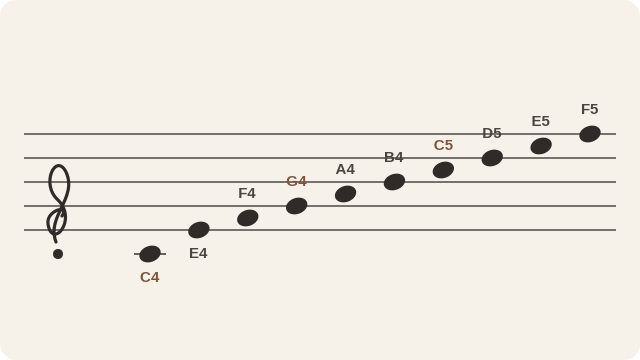
| Position | Note | How to recognise it |
|---|---|---|
| First ledger line below | C4 (middle C) | One short line under the staff |
| Space below the staff | D4 | Between middle C and the bottom line |
| Bottom line | E4 | Lowest of the five staff lines |
| First space | F4 | Space above E4 |
| Second line | G4 | The line the clef curls around |
| Second space | A4 | Space above G4 |
| Third line | B4 | Middle line of the staff |
| Third space | C5 | An octave above middle C |
| Fourth line | D5 | Line above C5 |
| Fourth space | E5 | Space below the top line |
| Top line | F5 | Highest of the five staff lines |
Above F5 the pattern continues on ledger lines (G5 in the space, A5 on the first ledger line, and so on). That is covered in how to read ledger lines quickly.
Read them at speed with landmarks and intervals
Keep G4, C4 and C5 as instant notes. From G4, a step up is A4 and a step down is F4. A third up is B4. From C5, a step down is B4 and a third down is A4. You still know every letter on the chart. You find the ones between landmarks by distance, which is faster than restarting from E4 on every note. The method is in intervals for sight-reading.
Worked exercise
Name these treble notes, then play them an octave around and above middle C: the second line, the third space, the bottom line, the first ledger line below, the top line.
Answer: G4, C5, E4, C4, F5. A useful check: G4 is the clef line, C5 is an octave above middle C, and C4 is the ledger line below the staff. If those three are solid, the others are steps or skips from them.
Frequently asked questions
What are the treble clef notes on the lines and spaces?
From the bottom line up, the lines are E4, G4, B4, D5 and F5. The spaces are F4, A4, C5 and E5. The clef's curl circles the second line, G4.
Where is middle C in the treble clef?
Middle C (C4) sits on the first ledger line below the treble staff. The space just above that ledger line is D4, and the bottom line of the staff is E4.
How do I remember treble clef notes without a mnemonic sentence?
Lock three landmarks: G4 on the clef line, C4 on the first ledger line below, and C5 in the third space. Name nearby notes as steps and skips from those anchors. Mnemonics can introduce the five line letters once; they are slow if you recite them for every note.
Which piano keys do the treble staff notes use?
The treble staff, with a couple of ledger lines, covers the notes around and above middle C, which the right hand usually plays. E4 is the bottom line, C5 sits in the third space, and F5 is the top line. Octave numbers tell you which C you are on: C4 is middle C, C5 is an octave above it.
Clef's treble note drills start from landmarks and move you on once a note is solid, so the chart becomes reading speed.
I build Clef.
Keep practicing with Clef
Short piano drills help you connect written notes, piano keys and familiar patterns.
Free to download. Annual starts with a 1 week trial, then $59.99/yr (just $5.00/mo), monthly $9.99, or $99.99 lifetime.