How to Read Ledger Lines Quickly
Read ledger lines quickly by using octave C landmarks, middle C, C2, C6, and naming the notes around them as steps and skips, instead of counting every extra line from the staff.
Counting every rung from the top or bottom line works, and it is slow. The faster way is to treat a few ledger-line Cs as landmarks, then read the notes around them as steps and skips, the same way you already read notes on the staff.
If you want the basic definition and the first-line examples, start with ledger lines explained and the first ledger line below the treble staff. This article is about reading them quickly. You can also drill them in the ledger line trainer.
Octave Cs as ledger-line landmarks
On the piano, each C is an octave above or below the last one. Those same Cs are easy to mark on the grand staff:
- C4, middle C: first ledger line below the treble staff, and first ledger line above the bass staff.
- C5: third space of the treble staff, already on the staff, an octave above middle C.
- C6: second ledger line above the treble staff, an octave above C5.
- C3: second space of the bass staff, an octave below middle C.
- C2: second ledger line below the bass staff, an octave below C3.
If a note sits near one of those Cs, name the C first, then the interval. A note on the first ledger line above the treble staff is A5, a third above G5 (the space above the top line) and a third below C6. You do not need to count F5, G5, A5 from the top line every time, once A5 itself is a familiar landmark.
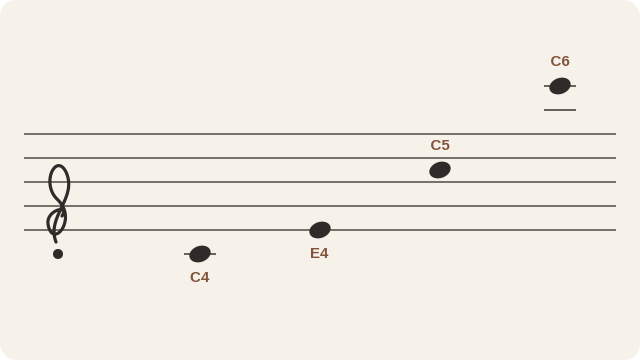
Above the treble staff
The top line is F5. The space above it is G5. The first ledger line is A5. The space above that is B5. The second ledger line is C6. From C6, the same pattern continues if the music goes higher. Learn A5 and C6 as quickly as you learned middle C. Then a written B5 is simply a step below C6.
Below the bass staff
The bottom line is G2. The space below it is F2. The first ledger line below is E2. The space below that is D2. The second ledger line below is C2. From C2, a step up is D2 and a third up is E2. Left-hand parts use this area constantly, so these notes deserve the same status as staff notes.
Worked exercise
Name and play:
- Treble: the first ledger line below the staff.
- Treble: the second ledger line above the staff.
- Treble: the first ledger line above the staff.
- Bass: the first ledger line above the staff.
- Bass: the first ledger line below the staff.
- Bass: the second ledger line below the staff.
Answers: C4, C6, A5, C4, E2, C2. The two C4 answers are the same piano key, written from opposite staves. C6 is two octaves above middle C. C2 is two octaves below it. A5 is a third below C6. E2 is a third above C2.
Frequently asked questions
What are ledger lines?
Ledger lines are short lines added above or below a staff for notes that sit outside its five lines. They continue the same line-and-space alphabet. The first ledger line below the treble staff is middle C (C4). The first ledger line above the bass staff is the same middle C.
How do I read ledger lines without counting every line from the staff?
Use octave landmarks. In treble, C4 is the first ledger line below, C5 is in the third space, and C6 is the second ledger line above. In bass, C3 sits in the second space, C4 is the first ledger line above, and C2 is the second ledger line below. Once you have the nearest C, the notes around it are ordinary steps and skips.
Do ledger lines work the same way in both clefs?
The pattern is the same: each new line or space is the next letter. The letters themselves follow the clef. A first ledger line below the treble staff is C4. A first ledger line below the bass staff is E2, not C.
Which ledger-line notes show up first in piano music?
Middle C, from both staves, appears immediately. Above the treble staff, A5 and C6 arrive early in many right-hand parts. Below the bass staff, E2 and C2 are common in left-hand parts. Train those before you worry about extreme ledger-line runs.
Clef includes ledger-line notes in its reading drills, so the short lines above and below the staff become as automatic as the five lines in the middle.
I build Clef.
Keep practicing with Clef
Short piano drills help you connect written notes, piano keys and familiar patterns.
Free to download. Annual starts with a 1 week trial, then $59.99/yr (just $5.00/mo), monthly $9.99, or $99.99 lifetime.