Intervals for Sight-Reading: Why They Make You Faster
Once you know the first note, intervals let you read the next one by its distance, a step, a skip or a leap, instead of naming every pitch from the clef again.
That is the difference between decoding and reading. Decoding starts from the clef, or from the bottom line, for every note. Reading keeps the first pitch as a landmark and treats everything nearby as a step, a skip or a leap.
This skill sits at the centre of the fastest way to learn to read sheet music. It also makes piano music on the grand staff more manageable, because each hand can follow its own line as a chain of distances.
How intervals are named
Count letter names inclusively. From C, D is a second, E a third, F a fourth, G a fifth, A a sixth, B a seventh, and the next C an octave. The same count works from any starting letter: E to G is a third, G to D is a fifth.
On the piano, that letter count still holds. C4 to E4 is a third and spans four semitones if the third is major (C to E) or three if it is minor (C to E-flat). You can read the staff position correctly with only the generic size. Quality comes later, when you need the exact black-key or white-key spelling.
What intervals look like on the staff
The staff makes size visible as a shape.
- A second sits on a line and the space next to it (or a space and the line next to it). On the keyboard that is a step: the next letter.
- A third sits on two lines with a space between them, or on two spaces with a line between them. Readers often call this a skip.
- A fifth sits on two lines (or two spaces) with an extra line or space in between. It looks clearly wider than a third.
- An octave repeats the starting letter, eight letter-steps later, and on the treble staff often takes you from a line or space onto a ledger line, or from a low line to a high space.
Odd sizes (third, fifth, seventh) keep the same type: line to line, or space to space. Even sizes (second, fourth, sixth, octave) change type: line to space, or space to line. Once you see that, you stop counting every rung.
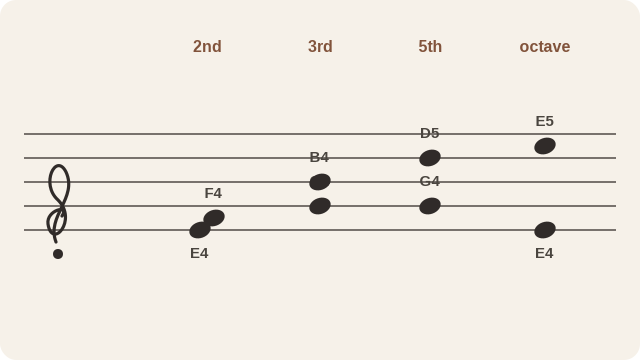
The example above shows harmonic intervals, stacked, because the distance is easiest to see that way. In a melody the same distances are written side by side. The shape is identical. For a quick check of any two pitches, you can also use the music interval finder.
A reading drill that shows the speed gain
Name the first note of a group in the usual way, from a landmark or from the clef. For every note after that, say the distance first, then the letter. Example, treble staff, starting on G4: up a second is A4, up a third from G4 is B4, up a fifth from G4 is D5, down a second from G4 is F4.
Time a two-minute set. Accuracy first, then the same patterns a little faster. If you miss a letter, check the interval shape before you count from the bottom of the staff again. Counting from the bottom is the fallback, not the default.
Worked exercise
Treble staff, starting note G4 (the line the clef curls around). Read this sequence of distances and write or play the resulting notes: up a third, up a second, down a fifth, up an octave, down a third.
Answer: G4, B4, C5, F4, F5, D5. Checks: G to B is a line-to-line third; B to C is a line-to-space second; C5 down to F4 is a fifth; F4 up to F5 is an octave; F5 down to D5 is a third (F5 is the top line, D5 is the fourth line, line to line). Play the sequence in the right hand and confirm each keyboard distance matches the staff shape.
Melodic and harmonic reading
Melodies ask you to move. Chords ask you to see a stack as a set of intervals from the lowest note (or from a note you already know). A C-E-G triad in close position is a third plus a third, or a fifth from the bottom to the top. Reading the bottom note, then two thirds, is faster than naming all three letters from scratch. For a worked chord on the treble staff, see how to read a stacked C-E-G chord.
Where this goes next
Once generic size is comfortable, add wider leaps, notes that arrive together (harmonic intervals), and interval quality. Sharps and flats change quality and keyboard position without changing the generic staff size: C to E-flat is still a third on the staff. That link is covered in sharps and flats on sheet music.
Frequently asked questions
What is an interval in music?
An interval is the distance between two notes, counted inclusively by letter names. C to D is a second, C to E is a third, C to G is a fifth, and C to the next C is an octave. The same count applies on the staff and on the keyboard.
Why do intervals make sight-reading faster?
Once the first note is known, the next note is a distance: a step, a skip, a leap. You no longer restart from the clef or from the bottom line for every pitch. The eye reads a shape, and the hand already knows how far to travel.
How can I recognise a third or a fifth on the staff at a glance?
Odd-numbered intervals (unison, third, fifth, seventh) stay on two lines or two spaces. Even-numbered intervals (second, fourth, sixth, octave) move from a line to a space, or a space to a line. A third is the next line or the next space of the same type. A fifth skips one line or one space of the same type.
What is the difference between a harmonic and a melodic interval?
A harmonic interval is two notes written and played together, stacked on the staff. A melodic interval is two notes written one after the other. The distance is the same; only the timing changes.
Do I need interval quality (major, minor, perfect) to read faster?
Not at the start. Generic size (second, third, fifth) is enough to find the next staff position and the next letter. Quality tells you the exact keyboard distance in semitones (a major third is four semitones, a minor third is three). Add quality once the generic size is automatic.
Clef trains interval reading in short drills: shape, leaps, numbers and harmonic intervals, so the next note is a distance you can see.
I build Clef.
Keep practicing with Clef
Short piano drills help you connect written notes, piano keys and familiar patterns.
Free to download. Annual starts with a 1 week trial, then $59.99/yr (just $5.00/mo), monthly $9.99, or $99.99 lifetime.