Sharps and Flats on Sheet Music
A sharp raises a note one semitone and a flat lowers it one semitone. The sign lasts for the rest of the bar at that staff position, then the key signature returns after the bar line.
A sharp raises a pitch by one semitone. A flat lowers it by one semitone. A natural cancels either spelling and returns the note to its unaltered letter. On the piano, that is usually a move onto or off a black key: F sharp is the black key to the right of F, B flat is the black key to the left of B. Two white-key exceptions are E sharp (the same key as F) and C flat (the same key as B), and their opposites F flat (E) and B sharp (C).
A single-note example of a flat already lives on this site: what a flat sign does to B4. This article covers the rules you need while reading a whole bar, and how accidentals sit next to key signatures.
The rule inside a bar
When a sharp, flat or natural is written immediately before a note, it applies to that note and to later notes on the same staff position in the same bar. Same staff position means the same letter at the same octave on that staff. An F sharp on the top line of the treble staff does not, by itself, sharpen an F an octave lower in the first space. If the composer wants that lower F sharpened too, the score writes another accidental, or a key signature already covers both.
The bar line ends the accidental. The next bar follows the key signature again, unless a new accidental is written. If a bar in C major shows F sharp, the first F in the next bar is F natural unless a sharp is printed again.
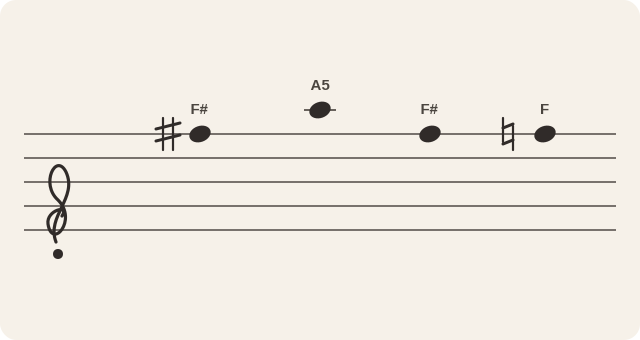
Courtesy accidentals
Composers and editors often print a small reminder after a bar line, or in a new octave: a natural on an F that was sharp a bar ago, or a sharp confirmed in a new register. That reminder is a courtesy accidental. The music would already be played that way if you followed the bar-line rule. The extra sign is there because readers do carry accidentals too far, and a printed reminder is cheaper than a wrong pitch.
Accidentals and interval reading
A sharp or flat does not change the generic interval on the staff. C to E is a third, and C to E-flat is still a third: both notes stay on their lines or spaces. What changes is the keyboard distance (a minor third is three semitones, a major third is four) and the key you press. Read the staff size first, then apply the accidental to the letter you landed on. See intervals for sight-reading.
Worked exercise
In C major, treble staff, one bar of 4/4. The notes are: F5 with a sharp, A5, F5 with no new sign, then, in the next bar, F5 with no sign.
Answers: F sharp, A, F sharp, then F natural. The second F5 in bar 1 is still sharp because it is the same staff position in the same bar. The F5 in bar 2 is natural because the bar line ended the accidental and the key signature has no sharp on F. Play it and listen for the two black-key Fs, then the white-key F after the bar line.
For a concrete B-flat case, including the piano key, use what a flat sign does to B4.
Frequently asked questions
What does a sharp or a flat do to a note?
A sharp raises the pitch by one semitone (one piano key, including black keys). A flat lowers it by one semitone. F sharp is the black key immediately to the right of F. B flat is the black key immediately to the left of B.
How long does an accidental last?
An accidental applies to later notes on the same staff position (the same letter at the same octave) for the rest of that bar. It does not automatically change the same letter in another octave, and it does not continue into the next bar. After the bar line, the key signature's spelling returns, unless another accidental is written.
What does a natural sign do?
A natural cancels a sharp or a flat, whether that alteration came from an earlier accidental in the bar or from the key signature. The note is played as an unaltered white-key letter (F, C, and so on), for the rest of that bar at that staff position.
What is a courtesy accidental?
A courtesy (or cautionary) accidental is a reminder printed after a bar line, or in a new octave, so you do not carry an earlier alteration too far. It does not change the rule. It confirms the spelling that is already in force.
How are sharps and flats different from a key signature?
A key signature sets the default spelling for a whole passage: in a sharp-key signature that includes F, every F is F sharp until the signature changes. An accidental is a local change to that default, for one staff position, for the rest of the bar. For reading signatures at a glance, see the key-signature guide in this cluster.
Clef's note-reading and key-signature drills include accidentals, so a sharp or flat is applied for the rest of the bar and dropped at the bar line.
I build Clef.
Keep practicing with Clef
Short piano drills help you connect written notes, piano keys and familiar patterns.
Free to download. Annual starts with a 1 week trial, then $59.99/yr (just $5.00/mo), monthly $9.99, or $99.99 lifetime.