How to Read Key Signatures at a Glance
Name a sharp key from the last sharp (the major tonic is one semitone above it) and a flat key from the second-to-last flat, then apply those spellings on both piano staves as you read.
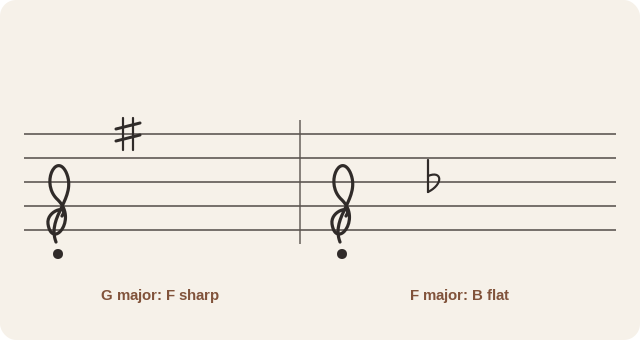
For sharp keys, look at the last sharp, the rightmost one. That note is the leading tone. The major tonic is one semitone above it: one sharp (F sharp) means G major, two sharps mean D major, three mean A major. For flat keys, one flat means F major. From two flats upward, the major tonic is the second-to-last flat: two flats mean B-flat major, three mean E-flat major, four mean A-flat major.
That identification is only the first move. You then read every affected letter as already sharpened or flattened, on both staves, until an accidental says otherwise. For how the signature changes the notes you name, see how key signatures change the notes you read. The key signature chart and key signature quiz are there for the fifteen standard signatures. This article is the at-a-glance method and the reading habit that follows.
The order of sharps and flats
Sharps always appear in this order: F, C, G, D, A, E, B. Flats always appear in the reverse order: B, E, A, D, G, C, F. A signature with two sharps is F sharp and C sharp, never some other pair. If you think you see a lone C sharp in the signature, look again; F sharp would already be there.
Sharp keys in one look
Name the last sharp, then go one letter up, and raise that letter if the last sharp was a natural letter's neighbour. In practice: last sharp F, tonic G; last sharp C, tonic D; last sharp G, tonic A; last sharp D, tonic E; last sharp A, tonic B; last sharp E, tonic F sharp; last sharp B, tonic C sharp. You can also memorise the list, but the last-sharp rule still works when a signature flashes past at the start of a line.
Flat keys in one look
One flat is B flat, and the major key is F. After that, read the flat just before the last one. That letter, already a flat in every case from two flats onward, is the major tonic: B flat, E flat, A flat, D flat, G flat, C flat. The last flat itself is the fourth degree of that major key, which is why the second-to-last flat is the useful one.
Relative minor
Each signature also belongs to a relative minor, a minor third below the major tonic. One sharp is G major or E minor. Two flats are B-flat major or G minor. To decide which, look at how the music ends, which pitch feels like home, and whether a raised leading tone appears (D sharp in E minor, for example). You still apply the same signature while you read. The minor tonic does not cancel the written sharps or flats.
Apply the signature while you read
Once the key is named, keep the affected letters in mind before the first note. In G major, every F is F sharp unless a natural appears. In F major, every B is B flat. The rule covers both hands and every octave. A mid-bar accidental still works as described in sharps and flats on sheet music: it lasts for the rest of the bar at that staff position, then the signature returns.
This is also where interval reading stays useful. The staff distance is unchanged. Only the keyboard spelling of one or more letters has changed. For related examples, see which keys have B flat in the key signature and what key is A-flat major the same as.
Worked exercise
Identify the major key, its relative minor, and the default spelling of the written note F4 (treble first space) and B3 (bass, space above the top line, just below middle C) in each signature:
- One sharp.
- Two flats.
- Three sharps.
- No sharps or flats.
Answers:
- G major / E minor. F4 is F sharp. B3 is B natural.
- B-flat major / G minor. F4 is F natural. B3 is B flat.
- A major / F-sharp minor. F4 is F sharp. B3 is B natural.
- C major / A minor. F4 is F natural. B3 is B natural.
Play each pair of notes in that spelling, then name one other letter the signature would change (C in A major is C sharp; E in B-flat major is E flat).
Frequently asked questions
How do I tell the major key from a sharp signature?
The last sharp (the rightmost one) is the leading tone, a semitone below the tonic. The major key is one semitone, and one letter, above that last sharp. One sharp (F sharp) is G major. Two sharps (F sharp, C sharp) are D major. Three sharps are A major.
How do I tell the major key from a flat signature?
One flat is F major (the flat is B). For two flats or more, the major key is the second-to-last flat, the one just left of the rightmost flat. Two flats (B, E) are B-flat major. Three flats (B, E, A) are E-flat major. Four flats are A-flat major.
How do I find the relative minor?
The relative minor shares the signature and has its tonic a minor third below the major tonic. G major (one sharp) shares that signature with E minor. F major (one flat) shares it with D minor. C major and A minor have no sharps or flats. The signature names both keys; the music's tonic, and the raised leading tone that often appears in minor, tell you which one you are in.
Does the key signature apply to both piano staves?
Yes. The same signature is written on the treble staff and the bass staff, and it applies to both hands, in every octave, until a new signature or an accidental changes the spelling.
What is the order of sharps and flats?
Sharps are always written F, C, G, D, A, E, B. Flats are the reverse: B, E, A, D, G, C, F. You never see a signature with a C sharp and no F sharp. That order is how you check that you have read the signature correctly.
Clef trains notes in a key and bass key signatures, so the default sharps or flats are already in force before the first note of the bar.
I build Clef.
Keep practicing with Clef
Short piano drills help you connect written notes, piano keys and familiar patterns.
Free to download. Annual starts with a 1 week trial, then $59.99/yr (just $5.00/mo), monthly $9.99, or $99.99 lifetime.