Bass Clef Notes on the Staff
Bass clef lines are G2, B2, D3, F3 and A3, and the spaces are A2, C3, E3 and G3. Read them faster from F3, C3 and middle C, then by interval.
The spaces, from the bottom up, are A2, C3, E3 and G3. The clef is an F clef: its two dots surround the fourth line from the bottom, and that line is F3. Middle C (C4) sits on the first ledger line above the staff, the same pitch as the first ledger line below the treble staff.
This page is the chart and a way to read it quickly. For the first explanation of the symbol, the letter trap from treble clef, and graded exercises, see how to read bass clef. The shared chart tool is the treble and bass clef notes chart.
The bass clef notes chart
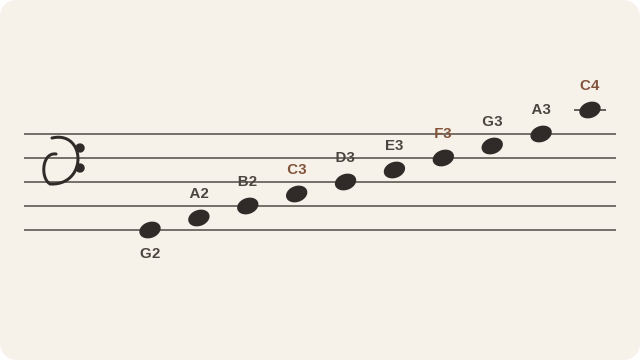
| Position | Note | How to recognise it |
|---|---|---|
| Bottom line | G2 | Lowest of the five staff lines |
| First space | A2 | Space above G2 |
| Second line | B2 | Line above A2 |
| Second space | C3 | An octave below middle C, a useful landmark |
| Third line | D3 | Middle line of the staff |
| Third space | E3 | Space above D3 |
| Fourth line | F3 | The line between the clef's two dots |
| Fourth space | G3 | Space above F3 |
| Top line | A3 | Highest of the five staff lines |
| Space above the staff | B3 | Between the top line and middle C |
| First ledger line above | C4 (middle C) | One short line over the staff |
Below G2 the alphabet continues on ledger lines. See how to read ledger lines quickly and the short pattern drill matching a bass C3-D3-E3 pattern to the keys.
Read them at speed with bass landmarks
Lock F3, C3 and C4. From F3, a step up is G3 and a step down is E3. A third down is D3. From C3, a third up is E3 and a fifth up is G3. This keeps you inside the bass map. Importing a treble mnemonic and shifting it usually produces the wrong letters.
Then read the next note as an interval from a landmark, the same way you do in treble. The shapes are identical: a third is still line-to-line or space-to-space. Only the letter attached to each position has changed. See intervals for sight-reading.
Worked exercise
Name these bass notes, then play them in the left hand below middle C: the fourth line, the second space, the first ledger line above, the bottom line, the top line.
Answer: F3, C3, C4, G2, A3. Checks: F3 is the dotted line of the clef, C4 is middle C above the staff, and C3 is an octave below that, in the second space.
Frequently asked questions
What are the bass clef notes on the lines and spaces?
From the bottom line up, the lines are G2, B2, D3, F3 and A3. The spaces are A2, C3, E3 and G3. The two dots of the clef surround the fourth line, F3.
Where is middle C in the bass clef?
Middle C (C4) sits on the first ledger line above the bass staff. The space just below that ledger line is B3, and the top line of the staff is A3.
Why do bass clef letters feel like the treble clef with the wrong names?
The staff looks the same, so it is easy to reuse treble letters. They are not the same map. In bass clef the fourth line is F3, not D. Read the clef first, then use bass landmarks (F3, C3, C4) so the letter comes from this staff, not from a remembered treble sentence.
Which piano keys do the bass staff notes use?
The bass staff covers the notes around and below middle C, which the left hand usually plays. G2 is the bottom line, C3 sits in the second space, F3 is the fourth line, and C4 is the first ledger line above.
Clef's bass drills keep this map separate from the treble one, then mix both clefs once the letters are stable.
I build Clef.
Keep practicing with Clef
Short piano drills help you connect written notes, piano keys and familiar patterns.
Free to download. Annual starts with a 1 week trial, then $59.99/yr (just $5.00/mo), monthly $9.99, or $99.99 lifetime.